What people say
Endorsements from Nobel laureates, leading researchers, and practitioners, followed by instructors and students who use the book.
“This exciting new text covers everything today’s aspiring data scientist needs to know, managing to be comprehensive as well as accessible. Like a good confidence interval, the Gabors have got you almost completely covered!”
— Joshua Angrist, Professor of Economics, MIT
“This is an excellent book for students learning the art of modern data analytics. This book combines the latest techniques with practical applications, replicating the implementation side of classroom teaching that is typically missing in textbooks. For example, they used the World Management Survey data to generate exercises on firm performance for students to gain experience in handling real data, with all its quirks, problems and issues. For students looking to learn data analysis from one textbook this is a great way to proceed.”
— Nicholas Bloom, Professor, Stanford Economics & Graduate School of Business
“I know of few books about data analysis and visualization that are as comprehensive, deep, practical, and current as this one; and I know of almost none that are as fun to read. Gábor Békés and Gábor Kézdi have created a most unusual and most compelling beast: a textbook that teaches you the subject matter well and that, at the same time, you can enjoy reading cover-to-cover.”
— Alberto Cairo, Professor, University of Miami, School of Journalism
“A beautiful integration of Econometrics and Data Science that provides a direct path from data collection and exploratory analysis to conventional regression modeling, then on to prediction and causal modeling. Exactly what is needed to equip the next generation of students with the tools and insights from the two fields.”
— David Card, Professor of Economics, University of California, Berkeley
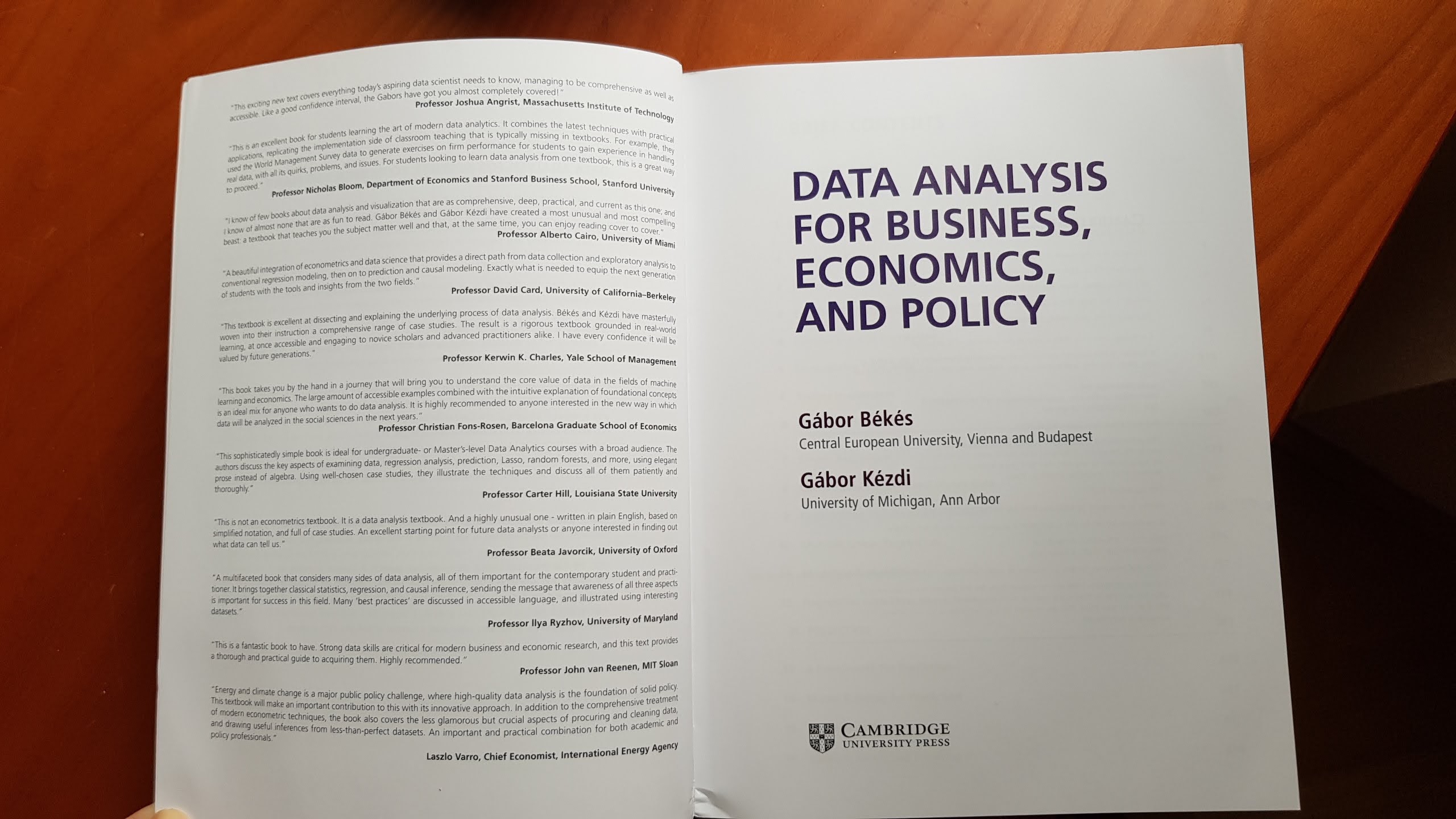
“This textbook is excellent at dissecting and explaining the underlying process of data analysis. Békés and Kézdi have masterfully woven into their instruction a comprehensive range of case studies. The result is a rigorous textbook grounded in real-world learning, at once accessible and engaging to novice scholars and advanced practitioners alike. I have every confidence it will be valued by future generations.”
— Kerwin K. Charles, Professor of Economics and Management, and Dean, Yale School of Management
“This book takes you by the hand in a journey that will bring you to understand the core value of data in the fields of machine learning and economics. The large amount of accessible examples combined with the intuitive explanation of foundational concepts is an ideal mix for anyone who wants to do data analysis. It is highly recommended to anyone interested in the new way in which data will be analyzed in the social science in the next years.”
— Christian Fons-Rosen, University of California at Merced & Barcelona GSE
“This sophisticatedly simple book is ideal for undergraduate or Master’s level Data Analytics courses with a broad audience. The authors discuss the key aspects of examining data, regression analysis, prediction, Lasso, and random forests and more using elegant prose instead of algebra. Using well-chosen case studies, they illustrate the techniques and discuss them patiently and thoroughly.”
— Carter Hill, Professor of Economics, Louisiana State University
“This is not an econometrics textbook, but a data analysis textbook. And a highly unusual one — written in plain English, based on simplified notation and full of case studies. An excellent starting point for future data analysts or anyone interested in finding out what data can tell us.”
— Beata Javorcik, Professor, University of Oxford; Chief Economist, EBRD
“A multifaceted book that considers many sides of data analysis, all of them important for the contemporary student and practitioner. It brings together classical statistics, regression, and causal inference, sending the message that awareness of all three aspects is important for success in this field. Many ‘best practices’ are discussed in accessible language and illustrated using interesting datasets.”
— Ilya Ryzhov, University of Maryland Smith Business School — Decisions, Operations and IT
“This is a fantastic book to have. Strong data skills are critical for modern business and economic research, and this text provides a thorough and practical guide to acquiring them. Highly recommended.”
— John Van Reenen, Professor, MIT Sloan & Department of Economics
“Energy and climate change is a major public policy challenge, where high-quality data analysis is the foundation of solid policy. This textbook will make an important contribution to this with its innovative approach. In addition to the comprehensive treatment of modern econometric techniques, the book also covers the less glamorous but crucial aspects of procuring and cleaning data, and drawing useful inferences from less-than-perfect datasets. An important and practical combination for both academic and policy professionals.”
— Laszlo Varro, Chief Economist, International Energy Agency
From instructors
Colleagues who teach with the book. Longer comments are on the instructor feedback page.
“I would like to wholeheartedly praise this book. I am totally impressed by its depth, clarity and applications of the book. The exercises are highly applied and coming from industry-relevant questions which will be of highly interests for economics, business, or even data science students. The Online Resources are great with clear and detailed codes and instructions in R, Stata, and Python, which provide a rich range of approaches for students. I will highly recommend this book for my students if they would like to develop the tools and understandings of econometrics and data science techniques. I would like to thanks Bekes and Kezdi for their excellent book. It’s one of the best textbook in econometrics and data science that I’ve ever read.”
— Dr. Canh Dang, LSE Fellow, Department of Economics, London School of Economics (UK)
“I have reviewed the book, and I think it is excellent. I plan on using it as a supplemental book for my Business Strategy and Analytics module here at UCL School of Management. I find it to be quite exhaustive and very well organized. It is very consistent with how I organize my module. I think they covered nearly everything that I would want covered in a book like this.”
— Dr. Anil Doshi, Assistant Professor, UCL School of Management (UK)
“The structure of the book is revolutionary with respect to existing textbooks, both in terms of coverage and approach. In Part I (Data Exploration), rather than emphasising/pivoting around formal statistical procedures or properties of data generation processes, the authors focus on conceptual presentation and case studies, and yet, the intuitive concepts are rigorously framed. In Part II (Regression Analysis), I found Chapter 8 (‘Complicated Patterns and Messy Data’) particularly important to bridge the abstract, ideal configuration of regression analysis with practitioners’ problems emerging when facing actual data. Parts III and IV introduce frameworks allowing to predict (Part III) or explain (Part IV) a target variable. These latter parts evince epistemological depth in the authors’ conception of applied statistics, as well as an unrivalled, up-to-date organisation of topics, according to emerging trends in data science. Technical details are kept in “Under the hood” sections, allowing students to delve into more formal aspects of the topics presented. Finally, the distinction between ‘Practice Questions’ and ‘Data Exercises’ allows instructors to fine-tune practical sessions according to a differential emphasis on conceptual vis-a-vis hands-on aspects of module delivery.”
— Dr. Ariel Wirkierman, Lecturer in Economics, Goldsmiths, University of London (UK)
“Data Analysis for Business, Economics and Policy is an excellent and much needed companion for practitioners in various policy fields. It is not simply a textbook on a broad range of methods, but a hands-on guide for data analysis in practice. It guides the reader firmly through the process of actual empirical analysis, demonstrating how to answer policy and business questions through a broad set of case studies. While covering a large variety of topics, the book never loses focus of the most acute problems practitioners are likely to face. It should be definitely included in the welcome package of every junior data analyst.”
— Dr. G. Koltay, senior economist in the European Commission’s DG Competition Chief Economist Team (Belgium/EU)
“I have be using it as a supplementary textbook to a course in International economics at the Master level at Luiss University in Rome. The course has a data analysis component an the book is just what I needed. Updated, complete, full of practical examples and including R, Python and Stata codes. It is a pleasure to read and with a little bit of adaptation could fit well in any applied course in the social sciences. I recommend it!”
— Luca De Benedictis, Professor of International Economics at University of Macerata and LUISS Rome (Italy)
“I think what is amazing about it is not only how you „rush“ through important topics, which allows it to cover a lot in a short period of time. But what is really good is how you teach students to handle data, with recommendations on what to do with outliers etc. but also with lots of hands on. As a teacher - and now I am not sure I can mention it - I found the slides of course amazing. I don’t know how much life time you saved me with that!!”
— Alexandra Avdeenko, Uni Heidelberg, Research Director at the Center for Evaluation and Development (Germany)

From students
“I can’t think of anything that better represents how exceptional Gabors Data Analysis textbook is than the fact that instead of googling something I’d rather consult the book first. It definitely stays on my desk!”
— Zsuzsanna, Economics MA, CEU
You can see a list of programs that are using this textbook. For a one-page overview to share, download the flyer (PDF) or see the flyer page.